Alexandria Summer Fair is going ahead

The weather bureau having pronounced that the weather for tomorrow will be better than today, Alexandria Summer Fair is going ahead.

We might move a few activities to the school, and we might have to make
some adjustments to the schedule, but we’re going ahead.

The planned schedule is:
11:00 Start
11:30 Official Opening and Welcome to Country
12:30 Doggy Parade and Competition
2:30 Junior Photo Competition Winners Announced
3:00 Close

Blanket sellers and kids photos – registration opens at 10:00
Doggy Parade – registration opens at 11:00

Hope to see you there.

Corner of Buckland and Wyndham Sts.

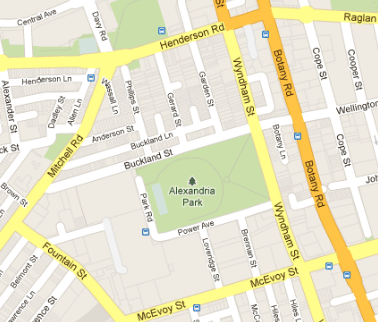
Alexandria Park – Corner of Buckland and Wyndham Sts.

Questions to Mayoral Candidates

Candidates attending the combined resident action group’s Mayoral forum have been asked to share their vision for Sydney, including a response to the following three questions:

Q1. In your opinion, have past development approvals adequately
considered the suburban infrastructure needed to service those
developments? Will the Green Paper’s proposed ‘enterprise zones’ make it
more or less likely that future developments will be adequately
supported by infrastructure?

Q2. Do you believe that Precinct Committees would improve “the flow of
two-way communication between community members and Council staff and
Councillors”? If so, do you think the City of Sydney would be better
served by the North Sydney model (open forums) or the Canada Bay model
(semi-random invitations)?

Q3. Do you support continuing the current policy of denying some
residents access to on-street and on-site parking, based on the age of
their property? Continue reading

When You Object to a DA

By Nick Fox

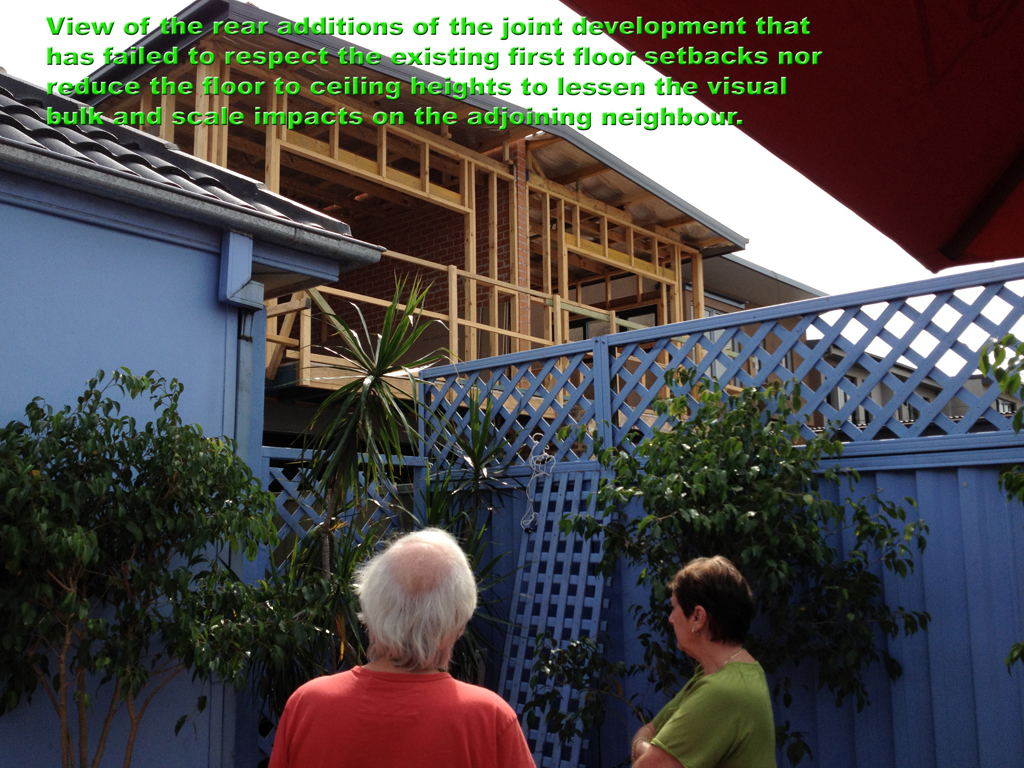
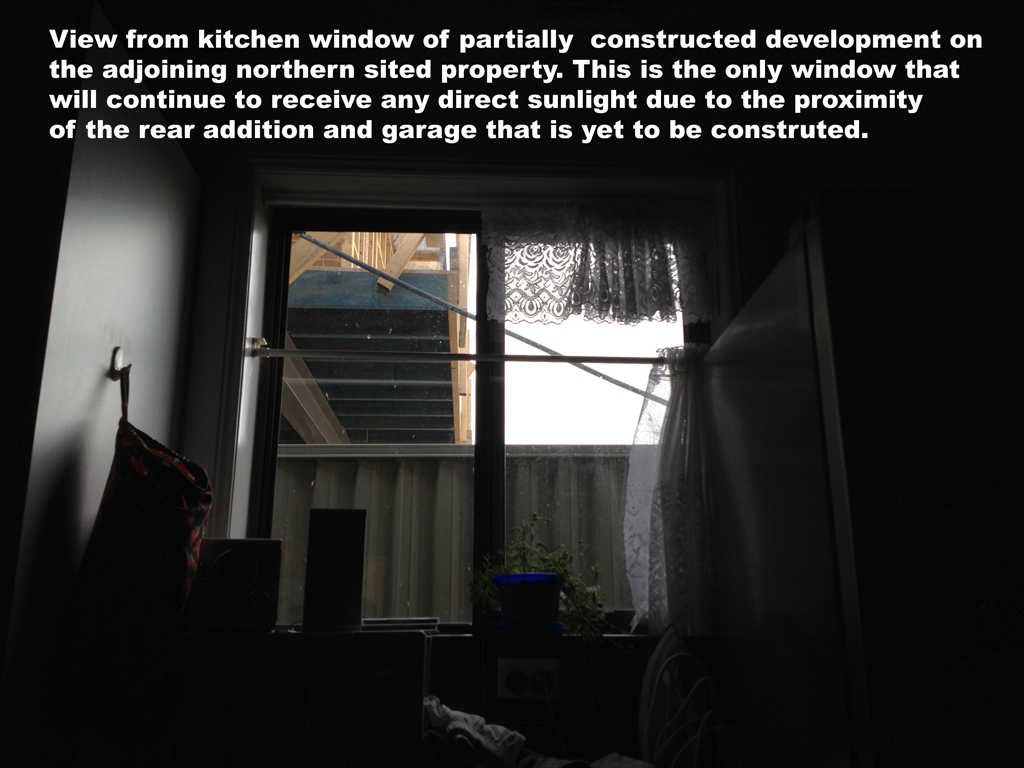
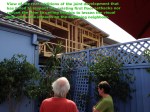
I had an onsite meeting with Councillor McInerney regarding the overshadowing issue at number 272 Belmont Street, Alexandria. A few things arose during this meeting that I think ARAG members need to be aware of.  Basically the following covers the DA process, how it now works and how you should proceed it you object to a DA near you.
1. Delegated Authority

Under delegated authority a single planner is allocated responsibility for evaluating all DAs under a set dollar value. The planner alone decides whether or not an alteration/addition complies with the DCP & LEP. The Draft DCP is a supposed to be a consideration for this process, but it seems to have more weight than the old South Sydney DCP, which is in fact the current control document. It will be repealed once the Draft DCP is Gazetted/approved by the State Government.

2. Councillor approval, is a thing of the past… well almost

In previous years a DA would automatically go before a meeting of full council for their consideration. This is no longer the case, but all is not lost and you need to be aware of your rights, because the planners, in Counciller McInerney’s own words, ‘are not required under law to inform you of them,’ so they don’t. If you’re getting a picture of a power hungry planning department, you’re probably on the right track. You need to raise your objection with all Councillors not just the planner or the planning department.

3. When you Object

Make sure you tell the planner that you want the DA looked at by Councillors for consideration as this takes the power for approval out of their hands – confirm this by email and/or letter. It is your right to raise an objection with Council representatives. The planner will probably tell you that ‘it won’t go before council;’ it can, but only if you insist that it does. Make sure to send a confirmation email covering your telephone conversation with any planner or  put it in writing. You need to create a paper trail as ‘he said she said’ arguments don’t hold water in the eyes of the law. I guess you have to balance your loss of amenity against a few hours writing to people.

4. Contact all Councillors

Contact all Councillors about the DA as soon as as your notified of a DA that you object to and include the site address and DA number.

5. Always

Always, always, always keep printed copies of all correspondence with council as they are essential should a council staff member deny having said something to you over the phone. This is the main reason why you should send a confirmation email after any discussion.

6. If the building looks too high
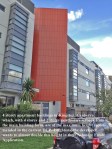
If the building looks too high on the drawings then it probably is. It is a requirement that adjoining properties on either side be shown on the drawings in order to establish the size and scale (bulk) of the development. If you don’t understand the drawings talk to somebody who does. Bulk can be controlled by reducing floor to ceiling heights to 2.4m and overshadowing through the use of skillion roofs. It’s common for designers to use existing ceiling heights throughout a new extension, but this will only disadvantage you. The overall height of a two storey extension can easily be reduced by 1m through height controls, but planners seldom point this out to a developer and the DCP has no provisions to control heights other than that of the existing ridge.

7. Get contacts details

Always get the council/planners contacts details (full name and direct number).

8. Record the time and date

Record the time and date you made the call. You may need this in the event of a dispute over who said what.

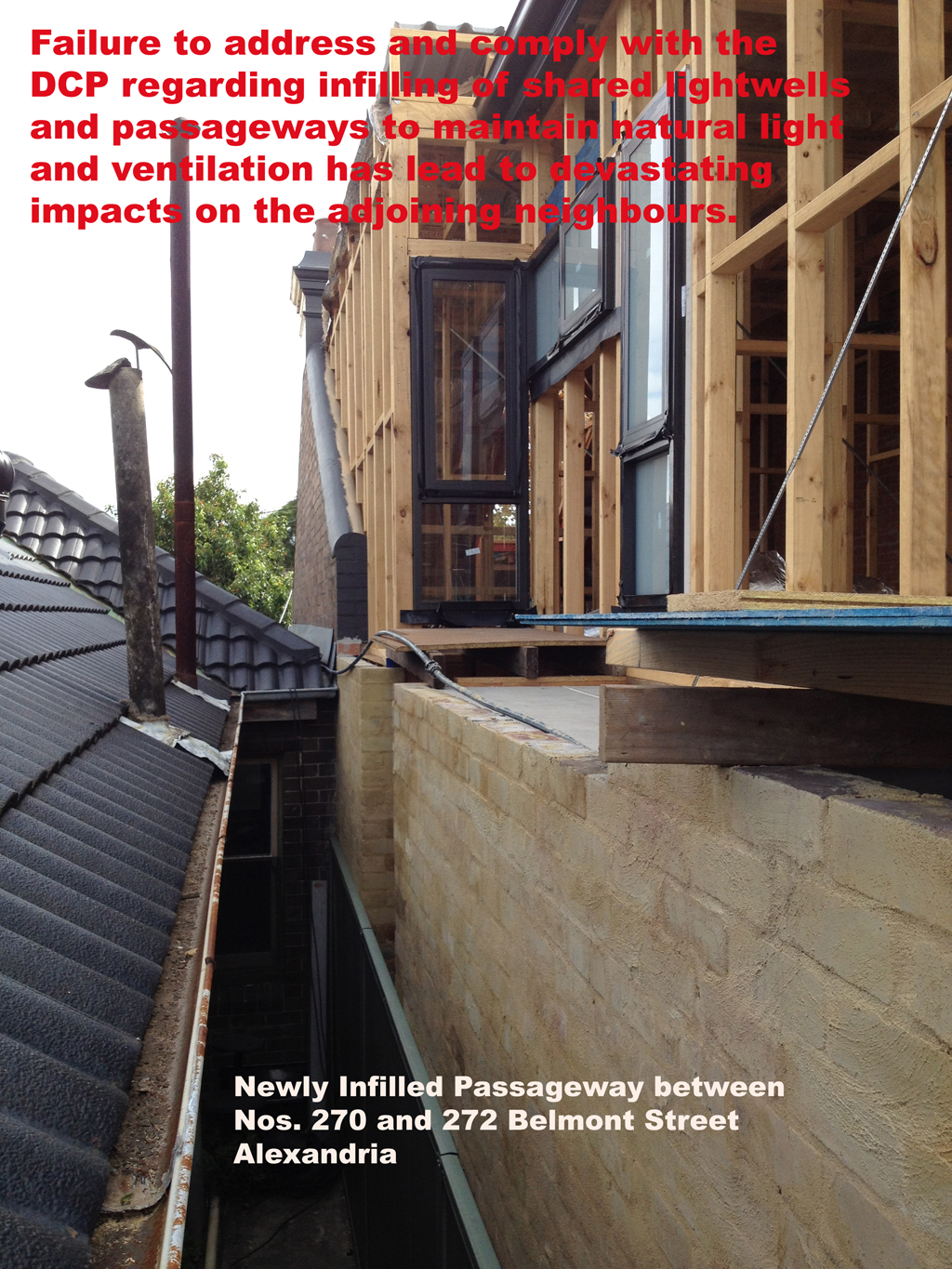
9. Windows on a light-well

Windows opposite each other on opposite sides of a light well are a no no.

10. If you don’t understand

If you don’t understand the drawings or what’s proposed get professional advice as the small up front cost may save you thousands rectifying a planners errors.

11. Shadow diagrams

Shadow diagrams are a great source of misleading information and should always be looked at with suspicion. Sunlight and shading is a technical subject and it’s a job that should be done by somebody who knows what they are doing. The old South Sydney DCP called the person responsible for creating shadow diagrams a ‘qualified person,’ but the new DCP says nothing about this at all. It may well be that they meant an architect, but that’s not clear.

12. Once the DA is approved

Once the DA is approved and a construction certificate is issued for a building, it’s basically all over and you cannot get the decision reversed.

13. Construction Certificate drawings

Construction Certificate drawings are more detailed than DA drawings and need to reflect the basic structure of the building. They are not the same as the DA drawings and you should ask the certifying authority if you can have, or view, a copy of them before the construction Certificate is issued. The construction certificate drawings for 270 Belmont Street were identical to the DA drawings, which is simply unacceptable.

14. Lighting analysis

The Draft DCP proposes developers may be required to have a lighting analysis done. This is a job for a professional not a drafting company, which is the service most commonly used by developers. If you’re going to be overshadowed then it’s worth while asking that this be done.

Key points

DA approval is happening at a much faster rate these days and time is very short once you lodge an objection. My advice is, don’t wait to hear back from the planner before contacting Councillors, because the planner may have made their decision by the time you hear back from them – contact them immediately. Planners are often paid a bonus based on their throughput, so there is a financial incentive to approve DA’s quickly.

Professional advice isn’t free, but that small up front fee and the advice you get, may save you a lot of heartache and costs. The only solution for the owners of number 272 Belmont Street is to have high quality Velux windows installed at a cost of over $8,000 and probably closer to $10,000. Given proper advice at the outset this could have been completely avoided, but possibly like you, the owners relied on a planning system that has changed beyond all recognition over the past few years. They thought they understood the process as the owner of the property is an ex South Sydney Alderman. Sadly the game has changed and planners evaluate whats on the paper in front of them very quickly; they are not really concerned with doing the right thing by you and all to frequently won’t. If you have enough spare cash you may want to take the matter to the Land & Environment Court, but you must do so within 6 months of the DA being approved – after that period of recently legislated time, you’re too late.
ARAG Review of ATP Parking Study

In 2010, the Australian Technology Park commissioned a parking study of
Alexandria to the south of the Park. Although comprehensive  in nature, the study missed the fundamental cause of the problem – the impact of ATP-generated commuter parking in our streets.

The City of Sydney Council seemed prepared to adopt the findings and recommendations of the ATP study unchallenged until ARAG raised its voice.

This document is ARAG’s detailed analysis of the ATP-sponsored parking study and is our response to the errors and omissions in the original study.

Irene Doutney: I find myself in opposition to the LEP

The following notes are from Greens Councillor Irene Doutney’s response to the LEP (Local Environment Plan) as given to the Council meeting of Monday 12/3/2012

This is what an FSR of 1.3:1 looks like.

Before I make my comments I would like to acknowledge all the work that has been done by staff and councillors to get the City Plan to where it is today. I also attended some of the City Plan meetings and it is with regret that I find myself in opposition to the LEP as it comes before us tonight.

I have grave concerns about parts of the LEP, in particular those to do with our heritage and conservation villages. I believe that the number of large developments including Harold Park, the Ashmore Estate, Green Square, the City and the renewal of Redfern and Waterloo should absorb the mass of development and meet the Metropolitan Strategy target numbers without having to upzone the villages that surround them.

We need to protect our villages as they are the soul of the City and with a balanced approach we can let new development happen in these renewal sites while protecting the conservation and residential villages.

I note that at last week’s Committee meeting the majority of submitters from the Resident Action Groups had their concerns diminished while the developer submissions were all given extra attention with 13 sites now being considered for future amendment. Not so for the villages however.

There has been significant media attention over the gross overdevelopment of the Ashmore estate, where the City’s plans for an already large development were ordered to become even larger by the Labor govt, who’d received thousands of dollars in donations from the site’s owners.

It is politically cowardly to have this section of the plan deferred to a point in the future that will almost certainly be after the next Council elections. The City should submit the plan with its proposed controls for sign off by the Minister along with the rest of the LEP.

This would allow the City to own its plans and have the people decide on them democratically, as well as forcing the Liberal government to show their hand – will they stand up for residents or follow the developer friendly line of Labor?

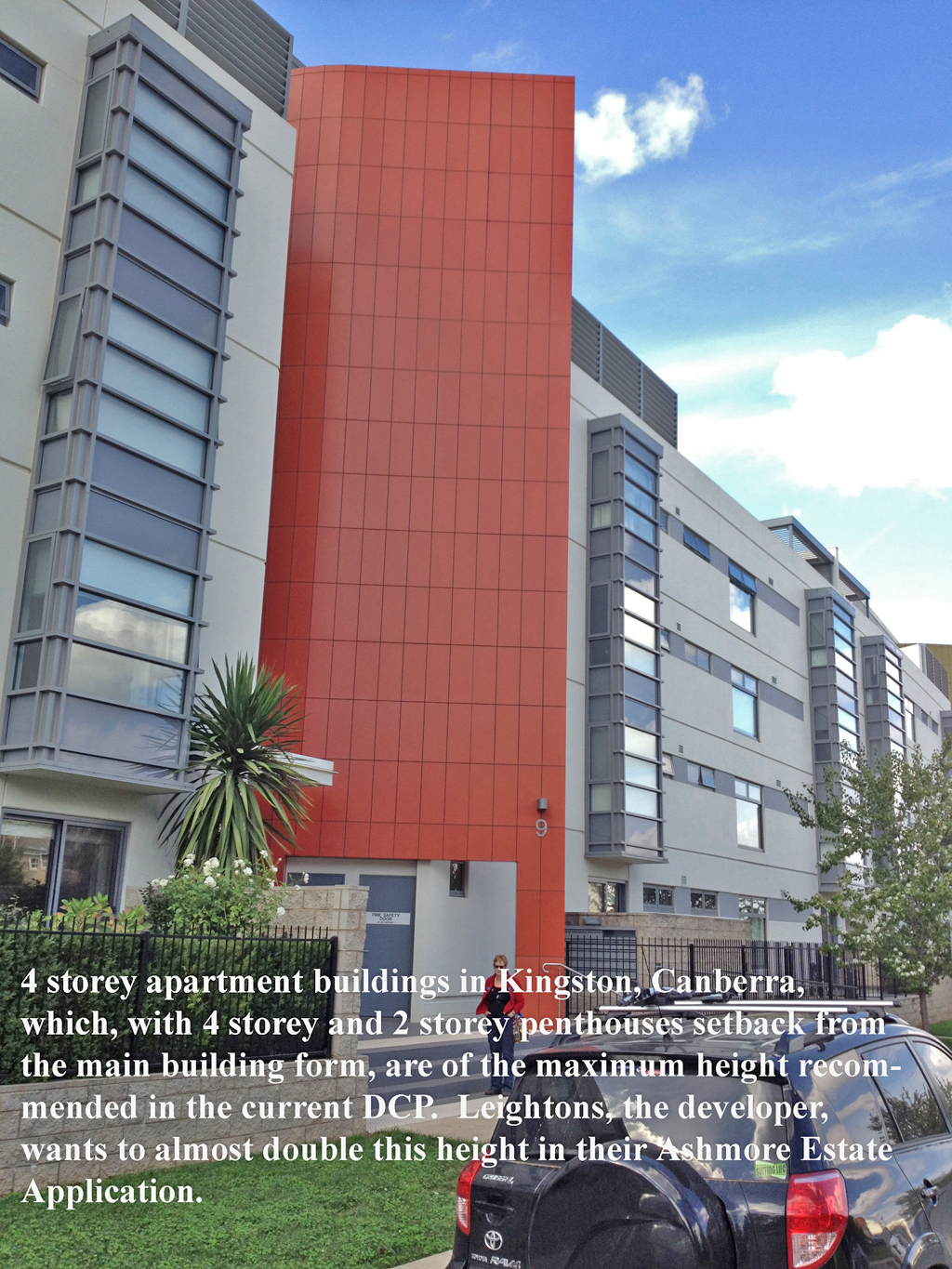
The controls for Ashmore Estate currently advocated by the City are around double what was permitted under the 2006 Ashmore DCP and if these were the only up-zonings adopted in the area we would still be asking Erskineville and surrounds to bear a significant burden.

However while Ashmore Estate gets the attention it is not the only part of Erskineville that is destined for overdevelopment under this plan.

The vast majority of the suburb, as well as surrounding areas of Newtown and Alexandria, looks set for major increases in density.

Under the South Sydney DCP almost the entirety of Erskineville had a maximum allowed floor space ratio of 1:1. It is noted that these controls have been routinely exceeded and it is for this reason that we are told that the permissible FSR should be increased.

Changing planning controls to meet these past exceedances is not a visionary way forward.

Higher FSR developments got through because developers were allowed to “slightly” exceed the controls. There’s no reason to think the new controls won’t also be exceeded – plans 10% in excess of controls are routinely allowed under SEPP 1. This means that for areas where FSR is increased to 1.25:1 we will see numerous developments pop up with an FSR of 1.37:1. When we next come to review the LEP, will we then up the allowed FSR to 1.37:1 to accommodate these?

You can see how this is a very poor precedent to set, and 1.25:1 is the lower end of new FSRs under the plan. The situation will be patently much worse in the areas where FSRs will jump from 1:1 to 2:1.

It’s also worth noting that the new LEP will be using a new definition of FSR, where internal wall cavities and communal stairways no longer count towards total floor area, meaning developers will be able to get between 5-17% more floorspace into their developments, depending on total size, even without an official increase in FSR.

Having made these points about trying to change development controls to match existing development I would also like to draw attention to the fact that the area is not uniformly high density as various reports imply.

The 2009 Urban Design Study into the area, used to justify the bulk of the density increases, has a map of existing conditions in the area which shows it to be anything but uniformly high density. Large areas of the suburb are predominantly less dense than the planning controls allow, calling into question the need to boost the density, when the residents are opposed to upscaling their village.

Examples include:

  • Newman St between Whitehorse and Angel Streets – only two out of 27 blocks are currently over 1.1:1 and none of these are over 1.25:1, yet all but one block is to be up-zoned to 1.25:1.
  • Block between Burren and Charles Streets – only 7 blocks are currently over 1.1:1, yet 86 out of 87 blocks are to be zoned 1.25:1 with the remaining block becoming 1.75:1.
  • Union St on both sides, between Erskineville Rd and Munni St – only 24 of 91 blocks are currently over 1.1:1 and none are over 1.25:1, yet 65 blocks are to be rezoned 1.25:1.

I would also like to briefly mention the residents of Chippendale who are concerned about the loss of Clause 37 which gave them some protection against certain types of development and I call on Council to put some heart into the LEP where people’s homes and futures are at stake.

Monday’s Committee Meeting

Some notes from Monday’s Committee Meeting:

The format was:

  •  everyone who was registered to speak was given 3 minutes
  •  council staff responded to the concerns raised
  •  councillors had the opportunity to challenge the response from the staff

This meant that unless an issue was supported by at least one councillor, council staff had the last word with no right of reply. And it was only the minority councillors (Meredith Burgmann, Shayne Mallard, Irene Doutney and Chris Harris) who raised issues. Clover’s  ‘independent’ councillors barely spoke all night.

The most common issue raised was floor space ratio (FSR) and building height – usually couched in terms of the application vs the buildings surrounding the site.  At least one speaker invoked a threat of legal action if they didn’t get the FSR they wanted (over a site in Zetland).

The city is trying to standardise its rules – and is upsetting people in South Sydney in doing so. The old South Sydney City used to allow mixed industrial – bulky goods, office space, light industrial, even limited residential in certain circumstances. This is all being rezoned (dezoned, one speaker said) so that many current uses will no longer be allowed.  There was the claim made that it is being selective in doing so – favouring Green Square over other nearby sites. Impacted sites include South Sydney Corporate Park and the Bunnings on Gardners Road.  Council said that there is a need for areas for “noisy and dirty work”, and it seems that these are to be it.

Michael from FOE spoke, pointing out that other councils are lowering their FSR ratios (at least in part in response to a change in the FSR formula which makes the calculation more generous to developers), pointed out that the studies being relied on are out of date, and called for new studies and a delay.  He also pointed out that 9+ stories is not fitting in with the surrounding area. Council’s response to the last point was to say that they only try to find fit with the surrounding area in heritage areas, not with ‘brownfield’ developments (replacing existing buildings, instead of building in empty (green) fields).

David Aitken and Anne Aitken both spoke, saying that there is no grounds for the increase in the FSR (floor space ratio), drawing attention to the well attended Ashmore meeting, commenting that the community is concerned but not informed, and calling for a delay: “council should be about informing … give us more time and we will make sure people are informed”.  Council’s response was that the 1.25:1 ratio is a maximum, not an entitlement, and that the current limit of 1:1 is regularly breached anyway. (!)

Irene expressed concern that we are facing the “Slow erosion of villages. Precedents get set and slowly the whole village changes”. Clover responded that council is committed to the ‘Village Character’ statements.

Meredith raised the concern that Council have been adding the words “including interiors” to heritage listing statements. The official response was that this doesn’t change anything.  There was discussion, but I didn’t feel that there was a clear resolution either way.

There is another meeting tomorrow night (Thursday), this time of the CSPC (Central Sydney Planning Committee), which will cover a lot of the same material, as will a full meeting of Council on Monday.