Irene Doutney: I find myself in opposition to the LEP

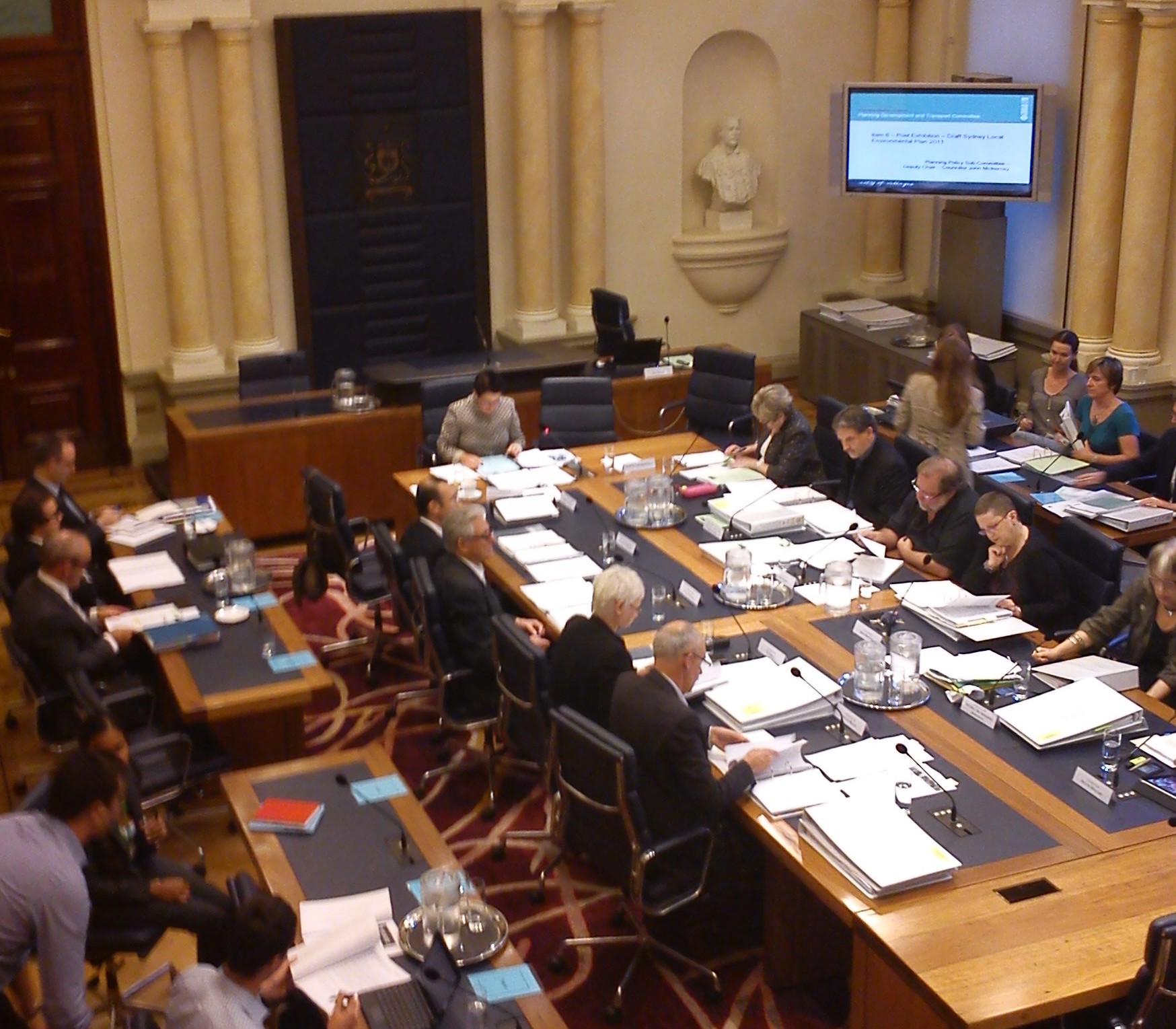
The following notes are from Greens Councillor Irene Doutney’s response to the LEP (Local Environment Plan) as given to the Council meeting of Monday 12/3/2012

This is what an FSR of 1.3:1 looks like.

Before I make my comments I would like to acknowledge all the work that has been done by staff and councillors to get the City Plan to where it is today. I also attended some of the City Plan meetings and it is with regret that I find myself in opposition to the LEP as it comes before us tonight.

I have grave concerns about parts of the LEP, in particular those to do with our heritage and conservation villages. I believe that the number of large developments including Harold Park, the Ashmore Estate, Green Square, the City and the renewal of Redfern and Waterloo should absorb the mass of development and meet the Metropolitan Strategy target numbers without having to upzone the villages that surround them.

We need to protect our villages as they are the soul of the City and with a balanced approach we can let new development happen in these renewal sites while protecting the conservation and residential villages.

I note that at last week’s Committee meeting the majority of submitters from the Resident Action Groups had their concerns diminished while the developer submissions were all given extra attention with 13 sites now being considered for future amendment. Not so for the villages however.

There has been significant media attention over the gross overdevelopment of the Ashmore estate, where the City’s plans for an already large development were ordered to become even larger by the Labor govt, who’d received thousands of dollars in donations from the site’s owners.

It is politically cowardly to have this section of the plan deferred to a point in the future that will almost certainly be after the next Council elections. The City should submit the plan with its proposed controls for sign off by the Minister along with the rest of the LEP.

This would allow the City to own its plans and have the people decide on them democratically, as well as forcing the Liberal government to show their hand – will they stand up for residents or follow the developer friendly line of Labor?

The controls for Ashmore Estate currently advocated by the City are around double what was permitted under the 2006 Ashmore DCP and if these were the only up-zonings adopted in the area we would still be asking Erskineville and surrounds to bear a significant burden.

However while Ashmore Estate gets the attention it is not the only part of Erskineville that is destined for overdevelopment under this plan.

The vast majority of the suburb, as well as surrounding areas of Newtown and Alexandria, looks set for major increases in density.

Under the South Sydney DCP almost the entirety of Erskineville had a maximum allowed floor space ratio of 1:1. It is noted that these controls have been routinely exceeded and it is for this reason that we are told that the permissible FSR should be increased.

Changing planning controls to meet these past exceedances is not a visionary way forward.

Higher FSR developments got through because developers were allowed to “slightly” exceed the controls. There’s no reason to think the new controls won’t also be exceeded – plans 10% in excess of controls are routinely allowed under SEPP 1. This means that for areas where FSR is increased to 1.25:1 we will see numerous developments pop up with an FSR of 1.37:1. When we next come to review the LEP, will we then up the allowed FSR to 1.37:1 to accommodate these?

You can see how this is a very poor precedent to set, and 1.25:1 is the lower end of new FSRs under the plan. The situation will be patently much worse in the areas where FSRs will jump from 1:1 to 2:1.

It’s also worth noting that the new LEP will be using a new definition of FSR, where internal wall cavities and communal stairways no longer count towards total floor area, meaning developers will be able to get between 5-17% more floorspace into their developments, depending on total size, even without an official increase in FSR.

Having made these points about trying to change development controls to match existing development I would also like to draw attention to the fact that the area is not uniformly high density as various reports imply.

The 2009 Urban Design Study into the area, used to justify the bulk of the density increases, has a map of existing conditions in the area which shows it to be anything but uniformly high density. Large areas of the suburb are predominantly less dense than the planning controls allow, calling into question the need to boost the density, when the residents are opposed to upscaling their village.

Examples include:

  • Newman St between Whitehorse and Angel Streets – only two out of 27 blocks are currently over 1.1:1 and none of these are over 1.25:1, yet all but one block is to be up-zoned to 1.25:1.
  • Block between Burren and Charles Streets – only 7 blocks are currently over 1.1:1, yet 86 out of 87 blocks are to be zoned 1.25:1 with the remaining block becoming 1.75:1.
  • Union St on both sides, between Erskineville Rd and Munni St – only 24 of 91 blocks are currently over 1.1:1 and none are over 1.25:1, yet 65 blocks are to be rezoned 1.25:1.

I would also like to briefly mention the residents of Chippendale who are concerned about the loss of Clause 37 which gave them some protection against certain types of development and I call on Council to put some heart into the LEP where people’s homes and futures are at stake.

Monday’s Committee Meeting

Some notes from Monday’s Committee Meeting:

The format was:

  •  everyone who was registered to speak was given 3 minutes
  •  council staff responded to the concerns raised
  •  councillors had the opportunity to challenge the response from the staff

This meant that unless an issue was supported by at least one councillor, council staff had the last word with no right of reply. And it was only the minority councillors (Meredith Burgmann, Shayne Mallard, Irene Doutney and Chris Harris) who raised issues. Clover’s  ‘independent’ councillors barely spoke all night.

The most common issue raised was floor space ratio (FSR) and building height – usually couched in terms of the application vs the buildings surrounding the site.  At least one speaker invoked a threat of legal action if they didn’t get the FSR they wanted (over a site in Zetland).

The city is trying to standardise its rules – and is upsetting people in South Sydney in doing so. The old South Sydney City used to allow mixed industrial – bulky goods, office space, light industrial, even limited residential in certain circumstances. This is all being rezoned (dezoned, one speaker said) so that many current uses will no longer be allowed.  There was the claim made that it is being selective in doing so – favouring Green Square over other nearby sites. Impacted sites include South Sydney Corporate Park and the Bunnings on Gardners Road.  Council said that there is a need for areas for “noisy and dirty work”, and it seems that these are to be it.

Michael from FOE spoke, pointing out that other councils are lowering their FSR ratios (at least in part in response to a change in the FSR formula which makes the calculation more generous to developers), pointed out that the studies being relied on are out of date, and called for new studies and a delay.  He also pointed out that 9+ stories is not fitting in with the surrounding area. Council’s response to the last point was to say that they only try to find fit with the surrounding area in heritage areas, not with ‘brownfield’ developments (replacing existing buildings, instead of building in empty (green) fields).

David Aitken and Anne Aitken both spoke, saying that there is no grounds for the increase in the FSR (floor space ratio), drawing attention to the well attended Ashmore meeting, commenting that the community is concerned but not informed, and calling for a delay: “council should be about informing … give us more time and we will make sure people are informed”.  Council’s response was that the 1.25:1 ratio is a maximum, not an entitlement, and that the current limit of 1:1 is regularly breached anyway. (!)

Irene expressed concern that we are facing the “Slow erosion of villages. Precedents get set and slowly the whole village changes”. Clover responded that council is committed to the ‘Village Character’ statements.

Meredith raised the concern that Council have been adding the words “including interiors” to heritage listing statements. The official response was that this doesn’t change anything.  There was discussion, but I didn’t feel that there was a clear resolution either way.

There is another meeting tomorrow night (Thursday), this time of the CSPC (Central Sydney Planning Committee), which will cover a lot of the same material, as will a full meeting of Council on Monday.

Who is the CSPC?

Contributed by Mike Hatton
The Central Sydney Planning Committee (CSPC) is a joint City of Sydney/State Government controlled Committee that has responsibility for major developments ($50+ million).

Its members and stated purpose are as below

City of Sydney Council representation:

The Lord Mayor Councillor Clover Moore MP (Chair)
City of Sydney
Town Hall House

Councillor John McInerney
City of Sydney
Town Hall House

Councillor Di Tornai
City of Sydney
Town Hall House

State Appointed Members

Mr Richard Pearson
Deputy Director-General – Development Assessment and Systems Performance
NSW Department of Planning

NSW Government Architect

The Hon Craig Knowles
(Non-government representative)

The Hon Robert Webster
(Non-government representative)

Background and role of the Central Sydney Planning Committee

The Central Sydney Planning Committee (CSPC) was established by the State Government in September 1988 under the provisions of the City of Sydney Act 1988.

That Act provides:-

“Sec 34. Members of the Planning Committee

(1) The Planning Committee is to consist of the following 7 members:

(a) the Lord Mayor of Sydney

(b) 2 councillors of the City of Sydney elected by the City Council

(c) 4 persons (2 of whom are senior State government employees and 2 of whom are not State or local government employees) appointed by the Minister administering Part 4 of the Planning Act, each having expertise in at lease one of architecture, building, civic design, construction, engineering, transport, tourism, the arts, planning or heritage.

(2) The Minister administering Part 4 of the Planning Act is to obtain the concurrence of the Minister administering the Public Works Act 1912 before appointing a senior State government employee under subsection (1) (c) if the employee is appointed because of his or her expertise in architecture or civic design.

(3) At least one of the senior State government employees appointed under subsection (1) (c) must be either the Director-General of the Department of Planning or a senior executive officer of the Department of Planning.

The Committee has the exclusive right to exercise the functions of City of Sydney Council in relation to the determination of applications for major developments (the estimated cost of which exceeds $50 million) and development applications seeking to vary a development standard under State Environmental Planning Policy No. 1 (unless delegated to Council to determine)

Sydney City Council to spike floor space ratios by 25%

Sydney City Council are meeting tonight. On the agenda is a proposal to raise floor space ratios in many areas from 1:1 to 1.25:1, a 25% increase above the current maximum.

The argument is that because there are already existing dwellings above the current limit, the limit should be raised for all new dwellings, to “provide flexibility”.

Anyone who’s concerned by this proposal may want to be at Sydney Town Hall tonight.

What we want is for the meeting to defer this decision for 4 weeks so that the community can assess and respond before the draft is finalised.

We’re not sure what time the proposal will be heard, only that it will not be before 6:00. We’ve been asked to be there by 5:45 to have time to register and so on.

Entry is from George Street and up the Grand Staircase located to the right-hand-side of the entry foyer, or take the birdcage lift, to Level 1. An accessible entry is available from Druitt Street with lift access to Level 1.

The full agenda is here: http://www.cityofsydney.nsw.gov.au/Council/MeetingsAndCommittees/2012/Committiees/050312/planning.aspx

Likely to be of particular concern to us are attachments G10, G7 and B5. Possibly others.

Ashmore Estate Submission

ARAG endorses the following resolutions that were passed at the Friends of Erskineville public meeting on 22 February 2012:

RESOLUTION 1 Residents do not accept the flawed proposed 2011 Draft Control Plan for the Ashmore Estate Development, (presently open to submission and comment), and which nominates building heights of up to 9 storeys and FSR’s up to 2:1, and which has been produced without any serious regard to the traffic and transport needs of the Erskineville/Alexandria area or the urban design quality and servicing of the proposed new residential development.

RESOLUTION 2      Residents acknowledge and accept that the gazetted 2006 Development Control Plan (DCP) for the Ashmore Estate Development which provides for buildings of up to 5 storeys with a site density of 1:1 (western sector) and 1.25:1 is the preferred plan at present for the development of the Ashmore Estate.

RESOLUTION 3       Residents request that Council do not consider any changes to the 2006 DCP until a full simulated Traffic and co-ordinated Transport study has been undertaken to assess the impacts that such an enormous increase in the population will have on local infrastructure and the community. The required Traffic and co-ordinated Transport study must be specific to the Ashmore Estate development and include a full analysis of the present overcrowded and inadequate public transport infrastructure and a detailed plan of amendment to that infrastructure to allow for the proposed increase in population envisaged under the 2006 DCP

RESOLUTION 4       Residents request that Sydney Water upgrade the inadequate piped drainage system in the Munni Street catchment area to properly address flooding and allow ground level access across the precinct. Residents note that such an upgrade is in line with Sydney Water policy to provide a system capable of managing a 20 year flood event

RESOLUTION 5      Residents request that an urban design study be undertaken specifically for the site and its surrounds by seeking the services of the city’s Urban Design Consultant, Jahn Gehl, in order to promote an alternative, sustainable and socially responsible design for the new Ashmore residential village, destined to become one of the “Sustainable Sydney 2030” centres in the Council’s City of Villages initiative

RESOLUTION 6       As the proposed residential development of the Ashmore Estate will result in the loss of an important employment generating centre, residents request an analysis of the social, economic and environmental impacts on the capacity of the existing physical and social community infrastructure and jobs market is undertaken to support the very large number of additional residents

RESOLUTION 7       Residents request that a working group composed of State government and City of Sydney delegates, as well as resident delegates, be formed and be known as the Ashmore Committee, and that this Committee have an overall advisory role in the development of the Ashmore Estate and any change to the gazetted 2006 DCP

In addition, we wish to raise some matters which relate specifically to Alexandria residents. Alexandria is now facing a future of being wedged between the ATP and the Ashmore estate, which are at either ends of the already congested Mitchell Road. The ATP development is only half complete, and as the City of Sydney knows, has already caused significant pressures on residential streets in Alexandria.

The DCP does not take into consideration the parking, traffic, public transport and social infrastructure pressures that an additional 6,000+ residents will place on the Mitchell Rd corridor. Nor does it take into consideration the ATP developments that are occurring at the north end of Mitchell Rd, the new Bunnings store, or other nearby developments.

ARAG is not against development, but it is against poorly planned development. We would therefore urge the Council to delay any decision on the DCP until a full traffic management plan for Alexandria and Erskineville is completed.

We note with concern that the City of Sydney Council has not paid due consideration to the provision of infrastructure to support what amounts to a doubling of the population of this area: public transport, stormwater drains and public schools.

We realise that these issues fall under the jurisdiction of the State Government, but we would expect Council to be a strong force advocating for better services on our behalf.

We also note that the City of Sydney Council has not paid due consideration to issues that do fall under the jurisdiction of the Council: provision of child care and parking to support the increased population of this area.

Instead, if the DCP is implemented, it will considerably worsen what is currently unmet demand for childcare places and on-street parking. We would expect Council to put the interests of existing and future residents foremost in these matters.

We do not accept that the dominant factor in car ownership is owning a parking space. The current situation in Alexandria is already proof that this is not so. The dominant factor in whether people own a car is whether they need cars. In Alexandria, both trains and buses are already inadequate. Given the current low levels of services, and given that the majority of residents of Alexandria do not work in Alexandria, many residents need to own cars.

Adding additional residents – many of whom will be commuters – while removing a local source of jobs will only make this situation more dire.

The unfairness of the proposal becomes even more stark when comparing Ashmore with Harold Park. Harold Park is over 10.5 hectares of which nearly 4 will be dedicated to open space (35% of the site) while the Ashmore proposal provides less than 5% open space – in an area with an already low space per capita.

Harold Park provides a further 1000sqm for affordable housing, with 1250 new homes being created. The developable area of Ashmore is approximately 14 hectares yet 3200 new residences are proposed – 2000 more than Harold Park.

The City’s website clearly shows the planning process for Harold Park, with technical studies and planning principles evident. There is no similar planning rationale for Ashmore – it has increased density without the necessary technical studies to show how this will be done.

We would urge Councillors to be consistent in aligning their actions with their vision for a ‘City of Villages’. Over-development that is not in character with the existing atmosphere of this area will destroy our villages, not enhance them.

Lift Redfern!

A petition has been started calling for lifts at Redfern Station:

To the Honourable the Speaker and Members of the Legislative Assembly of New South Wales.
The Petition of the residents of Darlington, Redfern, Waterloo, Chippendale and Alexandria brings to the attention of the House: the lack of access to Redfern Railway Station for residents and visitors who are elderly, parents with prams, mobility impaired passengers and passengers with luggage or goods.
The undersigned petitioners therefore ask the Legislative Assembly to call upon the Hon Gladys Berejiklian in her capacity as Minister for Transport to take immediate action to install lifts to the Redfern Station platforms to make accessible Redfern Station to all residents, workers and students.

To help, please download it, print it, sign it, and send it to:

Lift Redfern,
PO Box 1567,
Strawberry Hills NSW 2012

Alternately, hand them in at any of these Community Centres:

  • The Factory;
  • The Settlement, or
  • South Sydney Community Aid

More information is available at redwatch.org.au

Ashmore Development Public Meeting

Public Meeting:
22 February at 7.30pm
Erskineville Town Hall
104 Erskineville Road

The Ashmore industrial area is being developed.

Council proposes high density high-rise of up to 9 stories comprising
over 3000 apartments housing over 6000 people with only 1950 parking spaces.

This plan should concern all of us in Erskineville and beyond so please don’t be complacent because you live in a different part of the area. Trains, buses, traffic, parking and quality of life will all be affected.

Submissions on development close 29 February 2012

Learn more on proposed plan and how to make a submission at the public meeting and the Friends of Erskineville website:
www.erskinevillevillage.org or contact P.O. Box 427, Erskineville 2043, or email friends@erskinevillevillage.org

Parking meeting report

Around 120 residents attended our meeting at Alexandria Townhall to put questions to council and the ATP about parking and about the proposed expansion of resident parking restrictions.

The meeting heard that:

Feedback on the survey was above average – more than 400 responses from the 3200 surveys sent. The number of restricted parking places proposed for each street is driven by the number of survey responses from that street that were in favour of parking restrictions.

Whether an individual supported or opposed resident parking does not effect their entitlement to resident parking permits.

Cars with resident parking permits may still use unrestricted places – there is no requirement to prefer a resident parking space.

If more residents from a given street apply for resident parking permits than there are resident parking places, the number of resident parking places may be increased.

The State Government has changed the rules about how close to an intersection cars may be parked – the minimum distance has increased from 6meters to 10meters – approximately two car lengths – except where already signposted. Neither Council nor Rangers have any discretion in this matter.

The Council has no control over parking at the ATP site. The number of parks at the ATP site is capped at 1600 by the conditions in the ATP’s original development approval.

Resident parking is not a cure-all. Competition for parking will still exist, and will increase. The ATP is only 50% of its planned size, and there are developments like Ashmore coming.

One reason given for charging for parking at the ATP is that otherwise employees would be more likely to drive and that those who failed to find on-site parking would park offsite. It was proposed that a trial of free parking be held.

The ATP does offer discounted parking for employees, approximately $180 per month for uncovered parking, or $270 for underground parking. It was asked if residents could be entitled to this offer – answer to be provided.

It was said that having a rollerdoor/etc does not necessarily mean that the property will be considered as having parking for the purpose of calculating entitlement to parking – decision is made on a case by case basis. (But note also that Council’s website says that a potential parking spot is treated as a parking spot.)

Everyone now has the right to change their mind, or not. Council has requested feedback on the proposal, and may adjust the number of restricted parks depending on the result.

Friends of Erskineville will be holding a meeting on the Ashmore Development at 7:30 on the 22nd of February.

Council will be holding a Community Meeting on the Parking Study – probably on the 25th of February – to be confirmed.

Extension of Restricted Parking

The main topic of tomorrow’s ARAG meeting (Wed 8th, 7pm at Alexandria Town Hall, 73 Garden St) will be the proposed extension of Resident Parking Restrictions to additional streets around the Australian Technology Park.

We have arranged for several of our local councillors to be providing information and answering questions, including Irene Doutney, Meredith Burgmann, John McInerney, Chris Harris, Shayne Mallard and Di Tornai.

Parking FAQ

The following is a unofficial collection of some frequently asked question.

For the official story, visit Resident & Business Parking Permits and
Resident Parking Permit FAQs.

What will council do for residents to help with parking problems?

The only solution on offer in Alexandria is Residents Parking.

What does Resident Parking mean?

It means that in streets that ‘vote’ for Resident Parking,  non-residents will be limited in how long they can park – most likely to two hours.

How many Resident Parking permits can I get?

If you have 1 car, 1 permit per household.  If you have 2 or more cars, 2 permits.

BUT, if you have off-street parking,  that reduces your right to resident parking. For example, if you have one car park and one car, you are not entitled to a permit. If you have one car park and two+ cars, you are only entitled to one permit.

Also, residents of multi-unit developments approved after 8 May 1996 are not eligible for resident parking.

What about Visitor Parking?

Council offers Visitor Parking in some suburbs, but not in Alexandria.

And no, this isn’t fair or reasonable.

Why don’t builders put enough parking spaces into new buildings?

Because council won’t let them. The idea is that if you don’t let people have a parking space, they’ll decide that they don’t need cars. So far, there doesn’t seem to be much evidence to support this theory, but why let that get in the way.

What if I get rid of my ‘on site’ parking space?

Then you are entitled to a resident parking permit.  But you have to officially make it unusable, for eg, pay Council to remove your driveway and brick up the entrance.

Who determines which streets get Resident Parking?

Council will make a recommendation to each street that it thinks would benefit from Resident Parking. It’s then up to the individual residents of that street to let Council know what they want – Council will generally go with the majority opinion. Be warned that if the street next to you gets Resident Parking, and your street doesn’t, you will see a sudden spike in non-resident parking in your street.