Monday’s Committee Meeting

Some notes from Monday’s Committee Meeting:
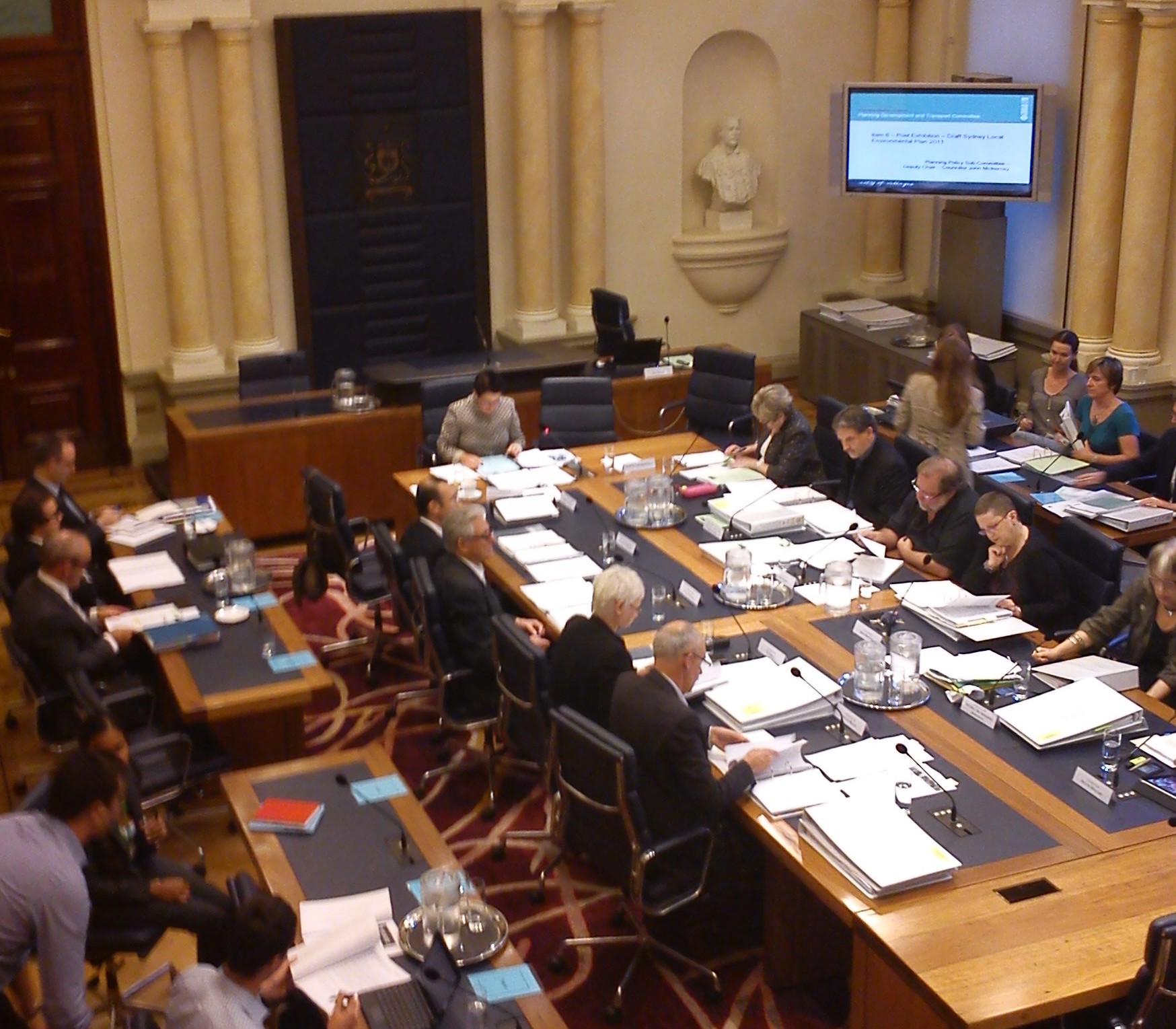
The format was:

  •  everyone who was registered to speak was given 3 minutes
  •  council staff responded to the concerns raised
  •  councillors had the opportunity to challenge the response from the staff

This meant that unless an issue was supported by at least one councillor, council staff had the last word with no right of reply. And it was only the minority councillors (Meredith Burgmann, Shayne Mallard, Irene Doutney and Chris Harris) who raised issues. Clover’s  ‘independent’ councillors barely spoke all night.

The most common issue raised was floor space ratio (FSR) and building height – usually couched in terms of the application vs the buildings surrounding the site.  At least one speaker invoked a threat of legal action if they didn’t get the FSR they wanted (over a site in Zetland).

The city is trying to standardise its rules – and is upsetting people in South Sydney in doing so. The old South Sydney City used to allow mixed industrial – bulky goods, office space, light industrial, even limited residential in certain circumstances. This is all being rezoned (dezoned, one speaker said) so that many current uses will no longer be allowed.  There was the claim made that it is being selective in doing so – favouring Green Square over other nearby sites. Impacted sites include South Sydney Corporate Park and the Bunnings on Gardners Road.  Council said that there is a need for areas for “noisy and dirty work”, and it seems that these are to be it.

Michael from FOE spoke, pointing out that other councils are lowering their FSR ratios (at least in part in response to a change in the FSR formula which makes the calculation more generous to developers), pointed out that the studies being relied on are out of date, and called for new studies and a delay.  He also pointed out that 9+ stories is not fitting in with the surrounding area. Council’s response to the last point was to say that they only try to find fit with the surrounding area in heritage areas, not with ‘brownfield’ developments (replacing existing buildings, instead of building in empty (green) fields).

David Aitken and Anne Aitken both spoke, saying that there is no grounds for the increase in the FSR (floor space ratio), drawing attention to the well attended Ashmore meeting, commenting that the community is concerned but not informed, and calling for a delay: “council should be about informing … give us more time and we will make sure people are informed”.  Council’s response was that the 1.25:1 ratio is a maximum, not an entitlement, and that the current limit of 1:1 is regularly breached anyway. (!)

Irene expressed concern that we are facing the “Slow erosion of villages. Precedents get set and slowly the whole village changes”. Clover responded that council is committed to the ‘Village Character’ statements.

Meredith raised the concern that Council have been adding the words “including interiors” to heritage listing statements. The official response was that this doesn’t change anything.  There was discussion, but I didn’t feel that there was a clear resolution either way.

There is another meeting tomorrow night (Thursday), this time of the CSPC (Central Sydney Planning Committee), which will cover a lot of the same material, as will a full meeting of Council on Monday.

Who is the CSPC?

Contributed by Mike Hatton
The Central Sydney Planning Committee (CSPC) is a joint City of Sydney/State Government controlled Committee that has responsibility for major developments ($50+ million).

Its members and stated purpose are as below

City of Sydney Council representation:

The Lord Mayor Councillor Clover Moore MP (Chair)
City of Sydney
Town Hall House

Councillor John McInerney
City of Sydney
Town Hall House

Councillor Di Tornai
City of Sydney
Town Hall House

State Appointed Members

Mr Richard Pearson
Deputy Director-General – Development Assessment and Systems Performance
NSW Department of Planning

NSW Government Architect

The Hon Craig Knowles
(Non-government representative)

The Hon Robert Webster
(Non-government representative)

Background and role of the Central Sydney Planning Committee

The Central Sydney Planning Committee (CSPC) was established by the State Government in September 1988 under the provisions of the City of Sydney Act 1988.

That Act provides:-

“Sec 34. Members of the Planning Committee

(1) The Planning Committee is to consist of the following 7 members:

(a) the Lord Mayor of Sydney

(b) 2 councillors of the City of Sydney elected by the City Council

(c) 4 persons (2 of whom are senior State government employees and 2 of whom are not State or local government employees) appointed by the Minister administering Part 4 of the Planning Act, each having expertise in at lease one of architecture, building, civic design, construction, engineering, transport, tourism, the arts, planning or heritage.

(2) The Minister administering Part 4 of the Planning Act is to obtain the concurrence of the Minister administering the Public Works Act 1912 before appointing a senior State government employee under subsection (1) (c) if the employee is appointed because of his or her expertise in architecture or civic design.

(3) At least one of the senior State government employees appointed under subsection (1) (c) must be either the Director-General of the Department of Planning or a senior executive officer of the Department of Planning.

The Committee has the exclusive right to exercise the functions of City of Sydney Council in relation to the determination of applications for major developments (the estimated cost of which exceeds $50 million) and development applications seeking to vary a development standard under State Environmental Planning Policy No. 1 (unless delegated to Council to determine)

Sydney City Council to spike floor space ratios by 25%

Sydney City Council are meeting tonight. On the agenda is a proposal to raise floor space ratios in many areas from 1:1 to 1.25:1, a 25% increase above the current maximum.

The argument is that because there are already existing dwellings above the current limit, the limit should be raised for all new dwellings, to “provide flexibility”.

Anyone who’s concerned by this proposal may want to be at Sydney Town Hall tonight.

What we want is for the meeting to defer this decision for 4 weeks so that the community can assess and respond before the draft is finalised.

We’re not sure what time the proposal will be heard, only that it will not be before 6:00. We’ve been asked to be there by 5:45 to have time to register and so on.

Entry is from George Street and up the Grand Staircase located to the right-hand-side of the entry foyer, or take the birdcage lift, to Level 1. An accessible entry is available from Druitt Street with lift access to Level 1.

The full agenda is here: http://www.cityofsydney.nsw.gov.au/Council/MeetingsAndCommittees/2012/Committiees/050312/planning.aspx

Likely to be of particular concern to us are attachments G10, G7 and B5. Possibly others.

Parking FAQ

The following is a unofficial collection of some frequently asked question.

For the official story, visit Resident & Business Parking Permits and
Resident Parking Permit FAQs.

What will council do for residents to help with parking problems?

The only solution on offer in Alexandria is Residents Parking.

What does Resident Parking mean?

It means that in streets that ‘vote’ for Resident Parking,  non-residents will be limited in how long they can park – most likely to two hours.

How many Resident Parking permits can I get?

If you have 1 car, 1 permit per household.  If you have 2 or more cars, 2 permits.

BUT, if you have off-street parking,  that reduces your right to resident parking. For example, if you have one car park and one car, you are not entitled to a permit. If you have one car park and two+ cars, you are only entitled to one permit.

Also, residents of multi-unit developments approved after 8 May 1996 are not eligible for resident parking.

What about Visitor Parking?

Council offers Visitor Parking in some suburbs, but not in Alexandria.

And no, this isn’t fair or reasonable.

Why don’t builders put enough parking spaces into new buildings?

Because council won’t let them. The idea is that if you don’t let people have a parking space, they’ll decide that they don’t need cars. So far, there doesn’t seem to be much evidence to support this theory, but why let that get in the way.

What if I get rid of my ‘on site’ parking space?

Then you are entitled to a resident parking permit.  But you have to officially make it unusable, for eg, pay Council to remove your driveway and brick up the entrance.

Who determines which streets get Resident Parking?

Council will make a recommendation to each street that it thinks would benefit from Resident Parking. It’s then up to the individual residents of that street to let Council know what they want – Council will generally go with the majority opinion. Be warned that if the street next to you gets Resident Parking, and your street doesn’t, you will see a sudden spike in non-resident parking in your street.

An open letter to Sydney of City Councillors

Dear Sydney of City Councillors

I am writing on behalf of the members of the Alexandria Residents Action Group to advise you that we regard the resident parking scheme as described by the Sydney of City’s parking officers to be at best, a stop gap measure to alleviate the very real problems we are experiencing as a result of the influx of parking by workers from Australian Technology Park.

We seek parking arrangements that meet the needs of our residents (whether or not they own a car) and arrangements that will accommodate parking for family and other visitors including community services such as Meals on Wheels and Community Nursing, trades people, delivery services and builders undertaking renovations.

The upcoming parking study by Sydney of City Council will only serve to offer residents solutions within the current parking policy framework, and is not considered to be comprehensive enough to meet our needs.

We believe that a more comprehensive survey of the entire Alexandria Local Government Area is required to develop a traffic and parking management plan that addresses the broader issues impacting Alexandria which include the developments at Australian Technology Park (existing and proposed) and the impacts of major developments such as the Ashmore Estate.

We urge you to listen to our very real concerns and do everything in your power to offer flexible comprehensive solutions – starting with the initiation of study to develop a parking and traffic management.

Background

Since 2008, residents close to Australian Technology Park have been coping with the pressure of employees using our streets for parking, while the ATP’s parking lot which can accommodate over 250 vehicles, remains locked and empty.

The management of ATP commissioned a parking survey which was released in a community ‘consultation’ in August 2010. The study recommended the introduction of resident parking and increasing the available parking in some streets by introducing angled parking.

These recommendations and the scope of the survey are totally unacceptable as they did nothing to address the root cause of the problem or accept any responsibility by the ATP to make any changes to alleviate the problems caused by their tenants.

The Sydney Metropolitan Development Authority have been asked by the State Government to investigate potential uses for the remaining land available at ATP. As we believe there is no planned increase to the onsite parking arrangements, any proposed additions will exacerbate an already unacceptable situation for residents.

Sincerely

Gary Speechley
Co-Chairman of Alexandria Residents Action Group

Meeting with Deputy Lord Mayor Marcelle Hoff

ARAG met with Deputy Lord Mayor Marcelle Hoff in order to to introduce ARAG and to communicate the most pressing issues affecting the Alexandria community:

  1. Parking – especially around the Australian Technology Park (‘ATP’)
  2. Development issues – especially Ashmore Estate
  3. Traffic and Public transport
  4. Australian Technology Park lighting

We went through the attached Presentation