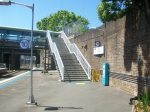
Mind the gap: Are we planning our major transport projects by a roulette wheel?

Ron Hoenig was standing up for Alexandria in parliament last week:

I call on the Government to reconsider its plans for the Sydney Metro. It has been almost two years since I first urged the Government to reassess its route and stations for the Sydney Metro Southwest project. I told the House then that the location of the Waterloo station was a mistake. It represented a missed opportunity to provide for the fastest growing and most densely populated urban renewal zone in Australia: Green Square east, between Zetland and Waterloo, near Danks Street. The New South Wales Government seems dead set on making yet another error with this project. Not only is the Waterloo stop in the wrong place, but the whole alignment through my electorate is wrong. Continue reading

March Meeting: Redfern Station, transport and trucks, residents’ forum

On the agenda for this month’s ARAG meeting:

  • Changes to Redfern Station – it’s started
  • Update on local transport issues from City of Sydney
  • Dangerous trucks in Alexandria: what can we do?
  • Residents’ forum: issues that affect you

The meeting will be at:

7pm, Wednesday 14 March
Alexandria Town Hall,
73 Garden St, Alexandria

Fix NSW Transport Rally – 17 Feb

There will be a rally next week calling on the Government to take a serious approach to fixing NSW’s transport:

17 February, from 14:00–16:00

March from Hyde Park north (Archibald Fountain) to Martin Place for speeches

https://www.facebook.com/events/1182204825212422/

Building a 20 billion dollar road to move a few thousand people an hour is madness. Either the tolls will be crippling for commuters, or the cost will cripple the state budget, or both.
Building a so called Metro with no more capacity than the rail line it replaces, that has stops 6 kilometres apart, where people are going to have to stand for 30km, complete madness.
Tearing up country rail lines that are vital to the continuing prosperity and even the survival of country towns and villages, worse than madness.
Come along to help the government understand, transport matters to us.

Agenda for October Meeting

The agenda for this month’s meeting is:

  • Council plans to ease & control traffic in local streets:
    Belmont, Lawrence, and Euston Lanes
  • the M4/M5 Link Environmental Impact Statement:
    reasons for Concern, how to object (Don’t delay, objections are due by Monday)

Hope to see you there:

7PM, Thursday 12 October
Cliff Noble Community Centre
24 Suttor St, corner of Renwick St

WestConnex, ATP, Sydney Metro, and the Alexandria Hotel

On the Agenda for tonight’s meeting we have:

  • WestConnex and Alexandria
  • Mirvac and the ATP
  • Quick updates on the Metro and the Alexandria Hotel

Meeting starts 7pm, Alexandria Town Hall.

Followed by drinks, nibbles and chat.

We’ll be having Mirvac’s Ross Hornsey along to talk about plans for the ATP, and what it’s going to take to make it work.

We’re hoping Jenny Leong will be present for our update on what WestConnex means for Alexandria (short version: 60,000 cars on Euston Road – that’s more traffic than Victoria Road can carry).

And we’ll be getting an update on the Metro and why Alexandria should care, and a quick update on the sad fate of our beloved Alexandria Hotel.

Hope to see you there.

Alternatives to WestConnex

In 2012, WestConnex was to cost $10 billion dollars, and the estimated benefits were $12. By 2013, it was to cost $11.5 billion dollars. At the end of 2014, it is now forecast to cost $14.9 billion dollars, ($14,900,000,000). All this to move perhaps an extra 100,000 drivers per day.

Surely, for that much money there have to be better options. And there are. There are a number of things that could be done that would, collectively, do more to relieve congestion, for less money, and without the pollution and all the other downsides.

Roads are an inefficient means of moving people. Estimates vary, but during morning peak hour under Sydney conditions, a motorway lane is typically considered to move between 2,000 cars per hour – with 1.1 to 1.2 people per car, that’s somewhere between 2,200 and 2,400 people per hour. A single dedicated bus lane can move perhaps 3,500 people per hour. Depending on the configuration, a single light rail line can move around 10,000 people. Whereas a single line of heavy rail can move up to 20,000 people an hour, the approximate equivalent of 9 or 10 lanes of cars.

Ecotransit Sydney, a public transport advocacy group, has been investigating alternatives:

For less than $2 billion the government could build a light rail loop that connects Balmain to Marrickville, thence Botany, continue to Randwick, enter the CBD, go back to Balmain via Victoria Road. As well, light rail could be built from Strathfield down Parramatta Road and into the CBD.

Light rail to Parramatta and up Victoria Road might each cost another $1.5 billion. Either would move a good percentage of the capacity of the entire WestConnex project, and could be built for a fraction of the cost and time of WestConnext.

A new train station could be added to the airport rail line at Doody St, midway between Mascot and Green Square, for perhaps $75 million.

– To take traffic off the M4, a Bus/train/park-and-ride interchange could provide an express service to the CBD from the former site of Pippita Station, on what was once the Abattoirs Branch line, now the Olympic Park line. A similar facility could be build at  Kingsgrove, to do the same for the M5, and for less than $100 million each.

– Any number of existing roads in and out of the city could easily, quickly and cheaply have one lane converted to bus only or to T2/T3 lanes. Such measures will reduce the number of cars but increase the number of people carried.

– A more dramatic alternative would be to reclaim two lanes of Sydney Harbour Bridge for rail, as envisaged by the original design. The consequence would be 6000 fewer motorists per hour and up to 50,000 extra rail passengers – for a fraction of the cost and time that building WestConnex will take.

Public transport will not suit everyone. It doesn’t have to. Many commuters are flexible, they switch between public and private transport as circumstances change. For example, when the M5 Cashback was introduced, congestion on the M5 increased significantly. Conversely, taking even small volumes of traffic off the road means that the remaining traffic moves far more quickly. Consider school holidays: reduction in the volume of traffic is small, the increase in the speed of traffic is significant. A nearly full road still moves quite quickly. A completely full road does not.

And has the Government considered these alternatives?  You guessed it, they haven’t. Or if they have, they haven’t released the result publicly.
Lift Redfern!

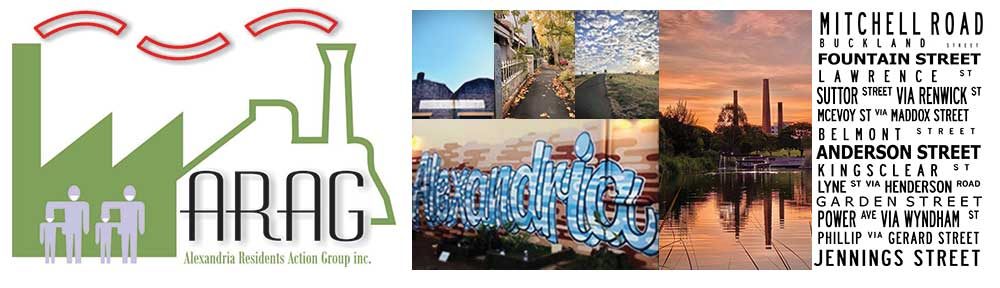
A petition has been started calling for lifts at Redfern Station:

To the Honourable the Speaker and Members of the Legislative Assembly of New South Wales.
The Petition of the residents of Darlington, Redfern, Waterloo, Chippendale and Alexandria brings to the attention of the House: the lack of access to Redfern Railway Station for residents and visitors who are elderly, parents with prams, mobility impaired passengers and passengers with luggage or goods.
The undersigned petitioners therefore ask the Legislative Assembly to call upon the Hon Gladys Berejiklian in her capacity as Minister for Transport to take immediate action to install lifts to the Redfern Station platforms to make accessible Redfern Station to all residents, workers and students.

To help, please download it, print it, sign it, and send it to:

Lift Redfern,
PO Box 1567,
Strawberry Hills NSW 2012

Alternately, hand them in at any of these Community Centres:

  • The Factory;
  • The Settlement, or
  • South Sydney Community Aid

More information is available at redwatch.org.au